
A more precise way to align capital with impact: moving beyond broad allocation toward targeted, real-world deployment.

Investors often express a desire to support underserved communities. The more difficult question is how to ensure that capital is deployed where it is actually needed and aligned with specific impact priorities. Impact matching is the process of translating investor intent into targeted, real-world deployment. It moves beyond broad allocation and toward a more structured approach that accounts for both investor goals and conditions on the ground.
Three levels of matching
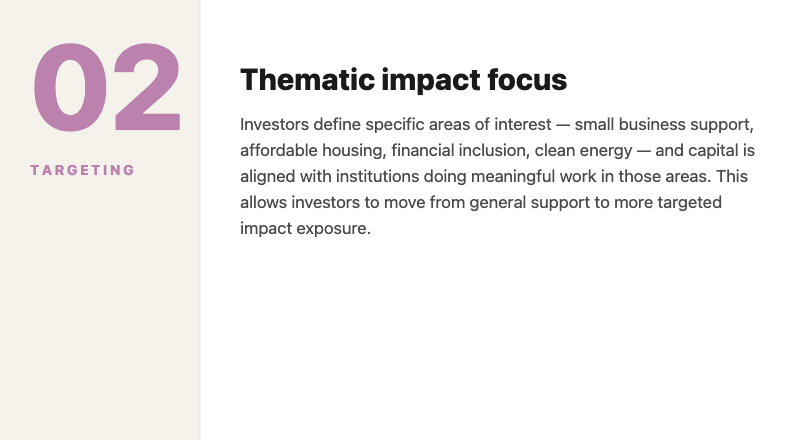
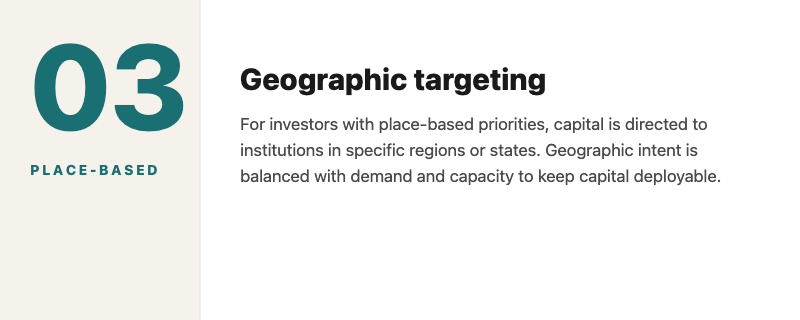
At CNote, impact matching operates across three primary levels: each adding precision without sacrificing flexibility.
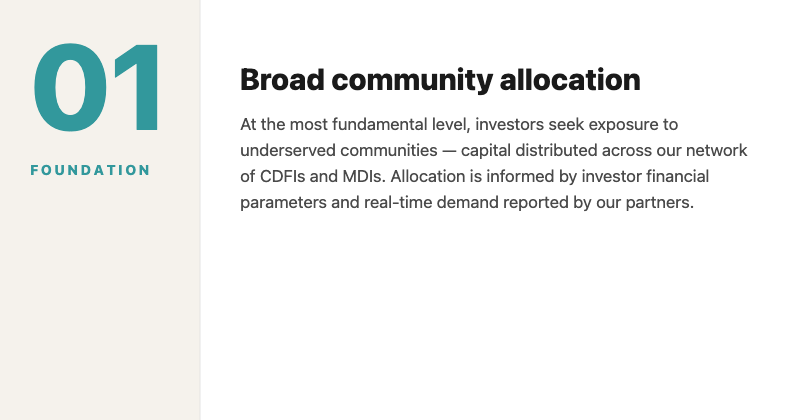
Demand varies. Institutions may not always need capital, or may not need it at a given rate, so capital is directed where it can be used effectively rather than distributed evenly.
The Impact Footprint Framework
A consistent framework that enables comparability across institutions so investors can see where impact is actually generated.
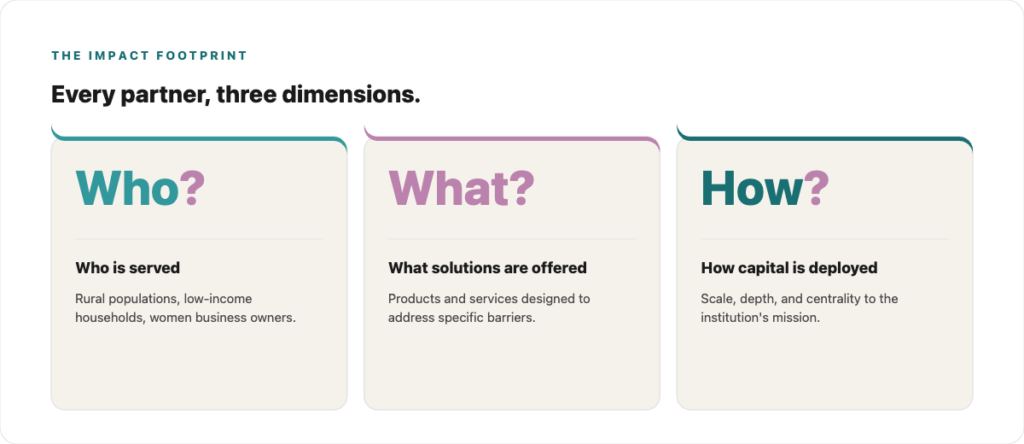
This framework allows for a more precise understanding of where and how impact is generated. It also helps distinguish between institutions where a given activity is core to their mission and those where it is more limited.
Not a one-time assessment
The initial mapping is conducted as part of CNote’s impact diligence process when institutions join the platform. This is not a one-time assessment. Ongoing data collection allows for continuous monitoring of how capital is deployed and how outcomes evolve over time.
By combining structured impact data with direct insight from our network, impact matching becomes an ongoing process rather than a static allocation decision. The result is a more responsive approach that aligns investor capital with opportunities where it can be deployed effectively and generate measurable impact.